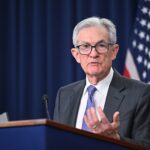
CAPATA Financial’s take on today’s FOMC press conference and announcement:
Notable comments from Chairman Powell during today’s FOMC press conference and announcement.
From the FOMC Statement :
- “Increase the System Open Market Account holdings of securities through purchases of Treasury bills and, if needed, other Treasury securities with remaining maturities of 3 years or less to maintain an ample level of reserves.”: As stated at the last FOMC meeting, the implementation note, specifically the inclusion of Treasury securities with maturities out to three years to maintain “ample reserves,” in our view leaves the door open for future balance sheet expansion and the easing of credit conditions in the name of controlling the Fed funds rate. We have long argued that the size and maturity composition of the balance sheet are the true primary monetary policy tools in the post–financial crisis, ample-reserves regime.
From the FOMC press conference:
- “The expectation is that we will see the effects of tariffs flowing through goods prices, peaking, and then starting to come down.”: Powell reiterated that the base case is that tariff-related inflation is likely to pass through as a one-time price increase. He followed up by noting that if you look beyond “goods” inflation and focus on “services,” you continue to see ongoing disinflation.
- “The U.S. federal budget deficit is uncontroversially on an unsustainable path…But, right now we’re running a very large deficit at essentially full employment, and so the fiscal picture needs to be addressed.”: Powell addressed a reporter’s question referencing recent bond market spikes, most notably in Japan, and whether a similar move could occur in the U.S. Many factors influence the long end of the yield curve (Treasuries at 10 years or longer), including economic growth, inflation expectations, volume of issuance, fiscal policy, and many others. One point we have consistently argued is that, since the shift to an ample-reserves monetary policy regime during the financial crisis, the influence of short-term rate movements on long-term rates has been diminished.
- “Geopolitical risk for us is a lot of it is around energy, oil, and so far, we haven’t—with for all the turmoil…oil prices have come down as you know, and so we don’t really see much.”: When pressed by a reporter about geopolitical risk as it relates to the U.S. economy, Powell referenced the overall muted response of oil prices over much of the past two years. Both Brent and WTI have traded below $60 per barrel at points over the past 12 months. This movement in oil prices has been a meaningful tailwind for the Federal Reserve in its fight against inflation over the past two years.
- “..the lore is that when GDP and the labor market get into an argument, in the end…the labor market data is more reliable. GDP data is very hard to collect and understand.”: This comment from Powell references the recent spikes in short-term GDP figures alongside slowing labor market data. Ultimately, he argues, labor market data is a much stronger indicator of future economic performance.
- “So, we look at those things, we don’t get spun up over particular asset price changes, although we do monitor them, of course.”: Powell was asked to comment on the recent spike in gold and silver. Typically, movements in precious metals—especially gold—reflect inflation expectations or, in many historical cases, a flight-to-safety response by investors. Powell reinforced that long-term inflation expectations remain well anchored and emphasized that this is a more important metric for the Fed to monitor than movements in precious metals.
In summary, the committee’s announcement on its rate decision was less of a news story than the forward guidance provided by Powell during his post-meeting press conference. His message, that the balance of risks on both sides of the Fed’s dual mandate of price stability and maximum employment has eased, and that neither has materially moved further from their stated goals between meetings, serves in his view, as justification for the pause.
With anticipation building around whom the President will appoint as Powell’s successor in May, the market appears to be asking one central question: Will the next Chair be sufficiently independent to maintain credibility in the fight against inflation?
If the President’s selection is viewed as too closely aligned with the administration and lacking credibility as an inflation fighter, one can only hope for a historical parallel to Truman’s appointment of William McChesney Martin in 1951. Shortly after appointing Martin, it is widely documented that he raised rates against Truman’s wishes. Following a chance meeting between the two, Truman reportedly had one word for Martin: “Traitor.”
Let’s hope history repeats itself and that President Trump appoints someone he might one day view as a “traitor” as well.

Source: Federal Open Market Committee (FOMC), Press Conference, January 28, 2026
The content is developed from sources believed to be providing accurate information. The information in this material is not intended as tax or legal advice. It may not be used for the purpose of avoiding any federal tax penalties. Please consult legal or tax professionals for specific information regarding your individual situation. This material was developed and produced to provide information on a topic that may be of interest. The opinions expressed and material provided are for general information, and should not be considered a solicitation for the purchase or sale of any security.
CAPATA Financial LLC offers wealth management services through various unaffiliated companies including advisory services offered by Diversify Advisory Services (“Diversify”) an SEC registered investment adviser. CAPATA Financial LLC offers additional investment services and securities through DFPG Investments, LLC., a broker/dealer, member FINRA / SIPC, and an affiliate of Diversify.