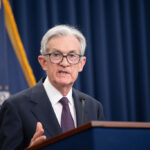
CAPATA Financial’s take on today’s FOMC press conference and announcement:
Notable comments from Chairman Powell during today’s FOMC press conference and announcement.
From the FOMC Statement :
- “Uncertainty about the economic outlook remains elevated. The Committee is attentive to the risks to both sides of its dual mandate and judges that downside risks to employment have risen.”: With the labor market weakening, the Fed now sees this mandate as the most at risk of deviating from its dual goals of maximum employment and price stability. Historically, once the unemployment rate begins to rise, it tends to climb quickly and to a greater extent than most economists predict.
- “The Committee will continue reducing its holdings of Treasury securities and agency debt and agency mortgage‑backed securities.” : The Fed announced the continuation of balance sheet runoff, with $5 billion of Treasury securities and $35 billion of MBS rolling off each month as part of ongoing Quantitative Tightening (QT). This raises the question of why the Fed is simultaneously loosening policy by lowering the Fed Funds rate while still tightening policy through QT. In theory, QT should steepen the yield curve and tighten credit conditions, even as rate cuts signal an easing stance. This combination could be interpreted as a hedge against the risk of inflation expectations becoming unanchored.
From the FOMC press conference:
- “GDP rose at a pace of around one and a half percent in the first half of the year, down from 2.5 percent last year. The moderation in growth largely reflects a slowdown in consumer spending. In contrast, business investment in equipment and intangibles has picked up from last year’s pace.”: We often compare the macroeconomy to a three-legged stool, with one leg representing consumer spending, another corporate spending (CapEx), and the third government spending. With the recent slowdown in GDP, Powell’s prepared statement emphasized that consumers have pulled back, while many attribute the uptick in corporate spending to favorable tax treatment from the tax and spending bill signed into law in July. The third leg, government spending, remains arguably too healthy given the fiscal path the federal government is on. Overall, the consumer drives the service sector, which accounts for roughly two thirds of GDP, and will be closely watched to determine whether business investment and government spending can continue to provide support for the other two legs.
- “In addition, wage growth has continued to moderate while still outpacing inflation.”: As highlighted above, the consumer’s ability to sustain wage growth above inflation is critical to maintaining the discretionary spending that supports both the service sector and the broader macroeconomy. As the Fed balances the risks of higher prices and rising unemployment, the financial health of the consumer will likely continue to weaken. With unemployment ticking up, future wage growth could fall below inflation, creating a clear headwind for the economy.
- “Yeah, I think you could look at this as a risk management cut…what’s different now is that you see a very different picture of the risks to the labor market..”: Powell made these comments in response to a reporter’s question about justifying the rate cut at this time. The Fed has had to distinguish between using its tools for macroeconomic stability and using them to implement monetary policy. A recent example was the Silicon Valley Bank weekend, when Powell emphasized that the committee’s actions were not meant to be interpreted as adjustments to monetary policy, but rather as measures to stabilize the broader banking system and economy. Powell is also credited with his 2019 “pivot,” when the committee cut rates three times early in the year to stabilize financial conditions.
- “Our expectation…has been that inflation will move up this year, but that the effect because of the effects on goods prices from tariffs, that those will turn out to be a one-time price increase, as opposed to creating an inflationary process.”: Powell has consistently warned the market that he and the committee are committed to ensuring that one-time price movements from tariffs remain just that. A student of history, Powell is determined to avoid the “bouncing ball” of 1970s inflation, when flare-ups occurred every couple of years until expectations became de-anchored and inflation turned into a self-fulfilling prophecy by the end of the decade.
In summary, Powell emphasized the committee’s recent shift toward focusing policy responses on a weakening labor market, noting that the balance of risks to the Fed’s dual mandate of maximum employment and price stability has shifted. This signals that the committee is currently more concerned about employment drifting further from its goal than about inflation. As the Fed moves its policy rate toward what it considers a more neutral level, it has also decided to continue gradually reducing its balance sheet with 5 billion in monthly Treasury runoff and 35 billion in MBS runoff through QT (Quantitative Tightening).
At the same time, the committee forecasts higher near-term inflation, with the SEP showing 3.0 percent and projecting inflation to remain consistently above the 2 percent target for the rest of the year, all while unemployment is rising.
With markets having already priced in a rate cut prior to the meeting based on forward guidance, the question remains: will the long end of the curve follow the Fed Funds rate lower, or will we see a repeat of 2024 when the 10 year Treasury yield rose (1%) 100 basis points even as the Fed cut the Funds rate by the same amount? If credit conditions, as measured by the 10-year Treasury, become untethered from policy adjustments to the Fed Funds rate, will the Fed be forced to adjust its communication and emphasize balance sheet size and maturity as the primary transmission tool of monetary policy? Put another way, are rate cuts as effective in today’s post financial crisis ample reserve regime?

Source: Federal Open Market Committee (FOMC), Press Conference, September 17, 2025
The content is developed from sources believed to be providing accurate information. The information in this material is not intended as tax or legal advice. It may not be used for the purpose of avoiding any federal tax penalties. Please consult legal or tax professionals for specific information regarding your individual situation. This material was developed and produced to provide information on a topic that may be of interest. The opinions expressed and material provided are for general information, and should not be considered a solicitation for the purchase or sale of any security.
CAPATA Financial LLC offers wealth management services through various unaffiliated companies including advisory services offered by Diversify Advisory Services (“Diversify”) an SEC registered investment adviser. CAPATA Financial LLC offers additional investment services and securities through DFPG Investments, LLC., a broker/dealer, member FINRA / SIPC, and an affiliate of Diversify.