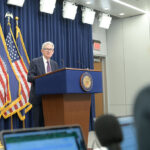
CAPATA Financial’s take on today’s FOMC press conference and announcement:
Notable comments from Chairman Warsh during today’s FOMC press conference and announcement.
From the FOMC Statement :
- “Inflation remains elevated relative to the Committee’s 2 percent goal, in part reflecting supply shocks that have driven price increases in certain sectors, including energy.”: The new Chairman wasted little time changing the Fed’s communications, reducing the policy statement to just a few concise sentences. The statement’s observation that inflation remained elevated, in part due to a supply shock, provides justification for leaving interest rates unchanged at this meeting. Because monetary policy operates primarily through the demand channel of the economy, the Committee should generally look through temporary supply-side shocks rather than respond to them with tighter policy. This reflects the textbook response to supply shocks and suggests that monetary policy may not be the appropriate tool to address supply-driven inflation.
From the FOMC press conference:
- “So I think financial markets perform best when they react to incoming data. I think the financial markets work less efficiently when they ask a question, how will the Federal Reserve react to that incoming information?…Financial market prices are probably the most important source of information to guide central bankers.”: Warsh’s response to a reporter’s question reinforces his view that the Federal Reserve should avoid providing forward guidance. This represents a notable shift from recent Federal Reserve chairs, who have argued that well-communicated forward guidance enhances the transmission of monetary policy by allowing financial markets to price in anticipated policy changes before they occur. Warsh appears to favor a framework in which markets respond primarily to incoming economic data rather than to central bank signaling..
- “…I don’t believe that we have a cruel choice. I don’t share the view that was expressed a few generations ago that Federal Reserve chairman show up at a podium like this and say, you got to choose and you’re going to have to decide whether you’re willing to tolerate higher inflation to put more people to work. I don’t believe in that.”: Warsh’s statement could be interpreted as suggesting that he believes the traditional Phillips Curve is no longer a reliable framework for understanding inflation dynamics. Jerome Powell has expressed a similar view, and many economists have observed that unemployment has fallen below the estimated natural rate of unemployment (u*) without generating the wage growth and price pressures predicted by the traditional model. The Phillips Curve holds that a tight labor market leads to rising wages, stronger demand, and ultimately higher inflation. If interpreted in this way, Warsh’s remarks may represent the most dovish comment of the entire press conference.
- “So I’d say it’s uneven. That’s perhaps a function of different transmission mechanisms of monetary policy, whether monetary policy is coming from our interest rate tool or our balance sheet tool…the balance sheet task force will be looking more at that subject.” This observation revisits a question we have raised in prior Fed Talks: in an ample reserves regime, is the Federal Funds Rate still the primary instrument of monetary policy, or has the balance sheet become the dominant policy tool? We have argued that the size and maturity composition of the Federal Reserve’s balance sheet are now the primary instruments of monetary policy. Furthermore, the liquidity created by a higher Federal Funds Rate through the payment of Interest on Reserve Balances (IORB, formerly IOER) has a stimulative effect by injecting liquidity into the financial system. Those interest payments are made on reserves created through past large-scale asset purchases, providing a tailwind to the banking system. This dynamic helps explain why monetary policy in an ample reserves regime, when relying primarily on the Federal Funds Rate as its transmission mechanism, can be characterized as “restrictive” while simultaneously providing accommodation to financial markets through interest payments on reserves. By contrast, balance sheet policy, through quantitative easing or by extending the maturity profile of the Federal Reserve’s holdings, can exert direct downward pressure on longer-term interest rates, making it a more powerful tool for influencing credit conditions and the broader economy.
In summary, Warsh delivered on his promise to overhaul the Federal Reserve’s communications strategy. He did not participate in the Summary of Economic Projections (SEP), stated that the central bank would refrain from providing forward guidance, and even questioned the future usefulness of both the SEP and regular press conferences, remarking that his former mentor believed you should hold press conferences only when you have something meaningful to announce.
His views differ markedly from those of his predecessors dating back to Bernanke, who believed that forward guidance enhanced the effectiveness of monetary policy by allowing financial markets to price in policy changes before they were officially implemented. Warsh’s philosophy appears to be the opposite. He has stated that he wants financial markets to reflect investors’ interpretation of incoming economic data rather than the signals and guidance provided by the Federal Reserve.
Many of Warsh’s comments harken back to concepts discussed during the Greenspan era, the only former Fed Chairman he referenced during his swearing-in speech. Greenspan famously spoke of “worker insecurity” during the late-1990s technology boom, hypothesizing that concerns over technological change would moderate wage demands while productivity gains offset inflationary pressures. From these early signals, if Powell could be viewed as a disciple of Bernanke, Warsh appears to be emerging as a disciple of Greenspan. Even the “Maestro” (Greenspan’s moniker, popularized by Bob Woodward) had much to learn when he became Chairman. In his memoir The Age of Turbulence, Greenspan recalled receiving a note from Paul Volcker after his first major policy move that simply read, “You are now a central banker.” Given the pace and scope of the changes Warsh appears intent on implementing, he may receive that same symbolic note from one of his predecessors sooner rather than later.

Source: Federal Open Market Committee (FOMC), Press Conference, June 17, 2026
The content is developed from sources believed to be providing accurate information. The information in this material is not intended as tax or legal advice. It may not be used for the purpose of avoiding any federal tax penalties. Please consult legal or tax professionals for specific information regarding your individual situation. This material was developed and produced to provide information on a topic that may be of interest. The opinions expressed and material provided are for general information, and should not be considered a solicitation for the purchase or sale of any security.
CAPATA Financial LLC offers wealth management services through various unaffiliated companies including advisory services offered by Diversify Advisory Services (“Diversify”) an SEC registered investment adviser. CAPATA Financial LLC offers additional investment services and securities through DFPG Investments, LLC., a broker/dealer, member FINRA / SIPC, and an affiliate of Diversify.