
CAPATA Financial’s take on today’s FOMC press conference and announcement:
Notable comments from Chairman Warsh during today’s FOMC press conference and announcement.
From the FOMC Statement :
- “Productivity growth and capital investment are strong. Job gains have kept pace with the workforce, and the unemployment rate has changed little. Inflation remains elevated relative to the Committee’s 2 percent goal, in part reflecting supply shocks that have driven price increases in certain sectors, including energy.”: In Chairman Warsh’s second post-FOMC meeting statement, he reiterated his preference for presenting only the facts. He touched on both sides of the Fed’s dual mandate, expressing satisfaction with the employment side while noting that inflation remains above target and that the supply shock in energy markets continues to play a role. As noted before, the textbook response is to look through a supply shock, since monetary policy works primarily through the demand side of the economy. However, that approach is being tested as the Iran war drags on, the supply shock persists, and its impact broadens.
From the FOMC press conference:
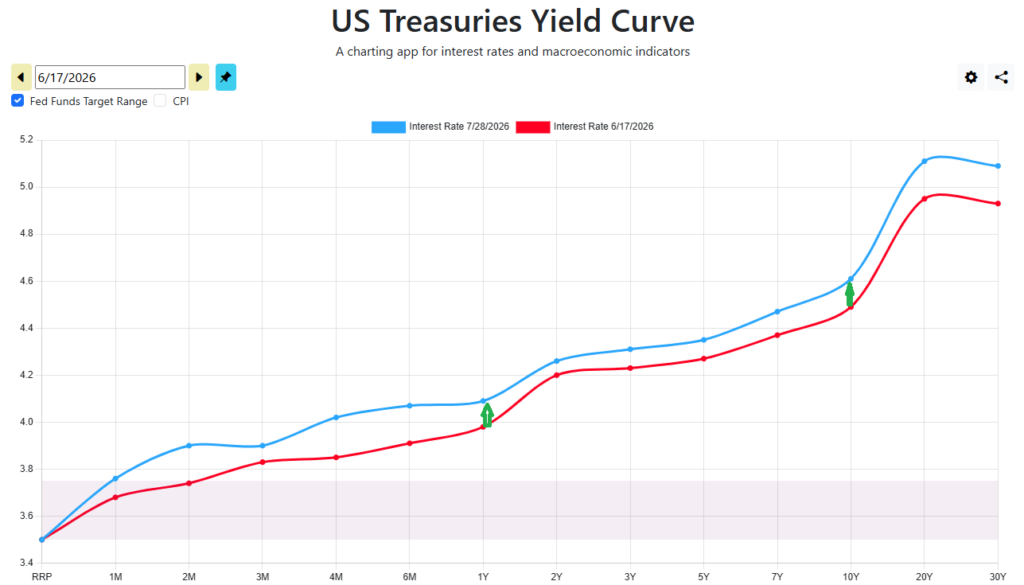
- “Two economic developments are worth highlighting. The first is a very notable change since our last meeting 42 days ago: nominal and real yields are materially higher across the Treasury curve. In fact, some of the increases in market interest rates between FOMC meetings are among the most significant in the last two decades, ranking around the top decile or so.”: Warsh’s prepared statement emphasized a point he continued to make throughout the press conference when answering reporters’ questions, that the market had done the Fed’s work for it between meetings by pushing nominal and real interest rates higher, particularly at the long end of the yield curve, which is most critical to credit conditions in the real economy. Some economists estimate that a 50-basis-point increase in the 10-year Treasury yield has an impact comparable to a 300-basis-point increase in the federal funds rate.
- “Market participants are learning to play the ball, not the referee—and market prices will continue to respond in the direction and magnitude they see fit…I want to stress, of course, that decisions by this Committee matter a great deal. And where necessary and appropriate, we will not hesitate to act.”: Warsh continued to emphasize the new normal of little or no forward guidance, allowing markets to react to real-time economic data while the Fed gauges that reaction between meetings. He is attempting to turn the tables on the market, allowing price discovery to take place and signaling a policy change in the federal funds rate only when he believes the magnitude of the market move was too small or in the wrong direction. As Warsh put it, “…markets have made decisions because we stepped back in part from trying to influence those [decisions].” In other words, if he agrees with how the yield curve has reacted to incoming data, he can hold the federal funds rate steady, effectively giving concurrence to the market’s move. Using a tennis analogy, he is letting the market serve first.
- “So I would not characterize what we did as anything like a pause…”: Warsh pushed back against a reporter’s characterization of the FOMC’s decision not to move the federal funds rate as a “pause.” He reiterated that markets had already pushed both nominal and real interest rates higher, a move that represents meaningful tightening in financial and credit conditions. He recognizes that many participants in the real economy do not borrow at the overnight rate and that rates further out on the yield curve have a much greater impact on borrowing costs and economic activity. If those rates have moved higher, as they have, then the market has already tightened financial conditions, and the FOMC does not need to push harder if it agrees with the direction and magnitude of that move.
- “…Coming out of the 2008 crisis, where, in crisis mode, we were purposely providing a lot of information. Trying to provide a lot of assurance. Telling a lot of people exactly what we were going to do. Offering forward guidance with clarity, as if we were tying our own hands behind our back. In crisis mode, that strikes me as a very prudent policy…”: Answering a reporter’s question, Warsh defended his move to pull back on forward guidance while offering a clear distinction between what he sees as a non-crisis environment today and how he would respond during a financial crisis. This gives markets reassurance that the toolkit used during the most recent periods of financial turbulence will ultimately prevail. Financial stability remains an overarching responsibility of the Federal Reserve.
In summary, Warsh emphasized the Committee’s recent shift toward reduced forward guidance, allowing markets to react to incoming data without guidance from the Federal Reserve. This retreat has already played out between his first two meetings, as markets pushed real and nominal yields higher across the yield curve, particularly at the long end, which is most influential to credit conditions in the real economy. This represents a fundamental shift in how markets interpret the transmission of monetary policy and what we believe is a much-needed transition in a post-financial-crisis, ample-reserves monetary policy regime. As argued in our previous Fed Talks, monetary policy tightness is determined not simply by the level of the federal funds rate, but by how longer-term rates respond. Warsh appears to be judging financial conditions through this broader lens rather than focusing solely on where the federal funds rate is set.
As the graph above shows, the 10-year Treasury yield moved significantly higher between meetings. If the goal of moving the federal funds rate is to tighten or loosen credit conditions, that move is only as effective as its impact on longer-term market rates. In essence, the market has moved and policy has tightened between meetings. The market has done the work for the Fed. Now the Fed needs to referee moves it may disagree with in magnitude or direction and use its tools when necessary to adjust policy.

Source: Federal Open Market Committee (FOMC), Press Conference, July 29, 2026
The content is developed from sources believed to be providing accurate information. The information in this material is not intended as tax or legal advice. It may not be used for the purpose of avoiding any federal tax penalties. Please consult legal or tax professionals for specific information regarding your individual situation. This material was developed and produced to provide information on a topic that may be of interest. The opinions expressed and material provided are for general information, and should not be considered a solicitation for the purchase or sale of any security.
CAPATA Financial LLC offers wealth management services through various unaffiliated companies including advisory services offered by Diversify Advisory Services (“Diversify”) an SEC registered investment adviser. CAPATA Financial LLC offers additional investment services and securities through DFPG Investments, LLC., a broker/dealer, member FINRA / SIPC, and an affiliate of Diversify.